Showing posts with label architecture. Show all posts

Sunday, June 14, 2009

London Tubes, 1926

Photobucket
Building a London Tube Station Tunnel.

Photobucket
Building a London Tube Station Tunnel, detail.

Photobucket
An underground Wonder
'These intricate tubes (near Mornington Crescent, London, N.W.) were so accurately laid that when they were joined up (after being started from each end) they fitted within a quarter of an inch. A hundred and sixty trains pass through them in an hour between North and South London.'

Original images and text from : Chatterbox (1926, Children's Annual), published by Wells Gardner, Darton & Co., London 1926. Artist unknown

Thursday, June 04, 2009

Federal Palace Hotel a.k.a. Federal Coffee Palace*

Photobucket
Image source: unknown contemporary magazine/newspaper advertisement c.1897+ Engraved by A.C.

Built in 1886 as a temperance hotel on the south western corner of King and Collins streets, the Federal Coffee Palace served all manner of beverages except alcohol. Its construction was instigated by a leader of the temperance movement in Victoria, James Miriams. It was the finest coffee house in Melbourne attracting visitors from around Australia, the rich and famous including international visitors. The abstinence movement had waned by the early 1890s. In 1897 a liquor license was acquired and it was renamed the Federal Palace Hotel.

The building's design was the result of a competition. The first prize winner, architectural firm Ellerker and Kilburn designed the exterior. The second prize winner, William Pitt designed the interior. Some of Melbourne's finest Victorian buildings were Pitt designs including the still standing Princess Theatre (1887), the Rialto and Olderfleet buildings (1890). The Age newspaper at the time was full of high praise for the building deeming it one of Australia's 'most splendid'.

Photobucket
The lobby interior, entrance from Collins Street*

The FPH was pulled down in 1972-73. For almost seven years after this it was used as a car park before being developed into an office block.

In the 1960s and 70s it was popular to pull down Victorian buildings deemed too large and old fashioned, and replace them with modern office blocks. We lost so many superb Victorian buildings this way though fortunately the National Trust and general public now value and protect our architectural heritage from further erosion.


*Information source, interior image and recommended further reading:
Latta, David, Lost Glories: A Memorial to Forgotten Australian Buildings, Angus and Robertson Publishers, 1986

Saturday, May 16, 2009

Tilt shift photography

Listening to: Some Guys have all the Luck by Robert Palmer

A while back I read on Bioephemera about tilt shift photography and recently Jessica posted about it as well. To be honest I didn't bother to understand the technology behind it - or why it's called tilt shift - since I was blown away by how damn cute it is! In short, you apply a filtering system to an image to make it look like it's a photograph of a model/miniature. It's something that prior to the digital age you could only do with specialised camera equipment.

Here is my best result using the online Tilt Shift Maker.
Photobucket
Colosseum, Rome. (originally taken in 2007)

On the site there is a good explanation about the technology, what you are simulating, and tips for making your own images.

Colours are enhanced and depth of field is reduced via adjustable sliders. Landscapes with a raised viewpoint- though not necessarily landscape format - seem to work best with the online simulator which is limited to horizontal alterations. It's surprisingly challenging to choose the right image to apply such a filter to convincingly. ie so it actually looks like a model and not a bad, digitally altered image.

Wednesday, April 15, 2009

Changes through vintage coloured postcards

Photobucket
Amsterdam, Munttoren (Mint Tower) c 1915 - 1920s

Judging by the contemporary photographs of Munttoren, one could recreate this scene in a photograph today. The surrounding buildings are still there, the sky line unchanged - though some tweaking in Photoshop would be necessary to get this level of colour! They have altered the adjoining guard house building (note windows and roof details).

Photobucket
Munttoren today.

Photobucket

Furkastrasse und Rhonegletscher (by J. Gaberell), c. 1925

German postcard of Furka Pass in the Swiss Alps near the Rhone Glacier.
Sadly one can not recreate this photo. The glacier is significantly smaller due to global warming accelerating its natural post ice age melt.

Photobucket
Rhone Glacier today
It's just peeking through in that valley. The rest is bare rock where the glacier used to be. It doesn't grow back. It shouldn't happen that quickly. Yes this really is the same part: check out that mountain in the background, it's the same one.

I started this post as a diverting vintage clippings thing. I liked the colours, architecture and slight surrealism of the blue ice which reminds me of the planet Krypton. Instead I ended up standing on a soap box! I don't apologise for that.

Saturday, September 13, 2008

Kitsch Koons meets the Sun King

The regal splendour of Versailles, France is about to house a major retrospective exhibition by sculptor Jeff Koons. It is a strange choice of artist for this Baroque venue, both in nationality and style. Many of the locals aren't happy about it at all. Having perused some of the 17 works online in context I am inclined to understand their view point. Some of these pieces looks cheap* and nasty in these luxurious surrounds: namely the full colour inflatable pool toys. The overtly kitsch, gold accented sculpture of Michael Jackson and Bubbles is a particularly controversial inclusion. I think that one is going to be awful where ever it's exhibited!

However other sculptures displayed at Versailles, both indoors and in the grounds, seem to work in a surreal way. Take the exuberantly pink Balloon Dog. At Versailles this piece is being displayed indoors - unlike in my photograph below - however going by the shot taken of it there I feel that it works.

Photobucket
Balloon Dog in Venice, 2007
digital photograph


It's a bit silly and out of place in these old surrounds, but it's fun. Must art bow its hat to history with great reverence? So what if it isn't high brow? That is not what defines art. Sometimes we forget that visual art doesn't have to be serious or meaningful. It can entertain and make you smile or chuckle as well.

Koons' sculptures are created to stand out and look a little odd anywhere. The oversized scale and mirror surface he uses in many of the pieces ensure that. This style is a modern expression of flashy luxury which may well have been appreciated by King Louis XIV himself!


*They are actually
really expensive of course. Koons is the most expensive living artist. British Damien Hirst -also known to court a bit of kitsch but more so controversy - is the world's second most expensive living artist. This is based on sales of their two most expensive works in 2007.

Sunday, May 07, 2006

Barcelona

With links :)

Food and Drink
Don’t expect the sort of service you expect in Australia. It’s rare.
0 According to our Indian waiter at Mickey’s Pizzeria
“Sangria is a very romantic drink.”
Therefore E3.95 for a pint of it, at the Irish pub down the street must be more special than we thought.
0 Maoz falafels are delicious, healthy and cheap. An excellent vegetarian’s option.
0 Freud b’ Art. A restaurant with gallery walls. Attentive service, relaxed atmosphere, and inventive, delicious, well priced food. We found it by accident, looking for another restaurant.
0 Cafe Lirica, La Rambla. For service, hot chocolate and tapa basics.

Art
Museum Gaudi @ Park Guel is the least interesting of the 3 main Gaudi attractions (there are others). Park Guel is nice but see it first then Casa Batllo, then the unfinished, awe inspiring, masterpiece that is the Sagrada Familia cathedral. We saw them in the opposite order :P Don’t bother with the ‘free’ audio tour at Casa Batllo. It’s goofy.

Image Hosted by ImageShack.us
The roof of Casa Batllo

Take a train to Figueres to see the Dali Theatre Museum, and the adjacent Dali Joies. This must be the world’s best Salavador Dali museum duo. Dali was involved in the Theatre Museum’s creation. You’ll see a few of his famous works some of which are murals. There’s also a real Mae West room with a special viewing lens so you can see it a bit like it is in the well-known painting. Dali Joies showcases his jewellery designs, which are exquisitely decadent. A few of them are animated. Be aware that you can buy basic Dali souvenirs (postcards, some of the sculptures, floppy watches galore) in the neighbouring shops. If you have time, I recommend checking them out before going to the museum so that you can see what is available as it’s generally cheaper than the official museum shop.

Shopping
Kukuxumusu! It means ‘kiss of the flea’ in Basque. It’s a design studio from Pamplona that designs quirky, funny, graphics for t-shirts (kids and adults), keyrings, stationery, postcards and several other products. The visual humour used is universal. We found the main store in Barcelona by accident. I got a pink t-shirt of Little Red Riding Hood kicking the wolf in the soft bits, and postcards to share the lurve. Their stuff is so cool!


Be aware of the Barcelona Card for train travel. It also entitles you to discounts at many of the main attractions, and a selection of restaurant and shops. This includes the well-stocked BCN Original Shop souvenir store under the main square, Placa de Catalunya and the smaller store near Placa de Sant Jaume. Both are also tourist information points.

Thursday, April 20, 2006

Random thought on Barcelona No. 1

It seems to be a growing trend to make people pay more and give them stuff they don't want - instead of paying less and paying extra for extras. It started with the weekend paper years ago
“Why am I paying extra for a great big wad of the Classified section? They’re already paid for by the people who place the ads. I don’t want to read them but I’m picking them up anyway because I’ve paid for them now. :P”

A recent example is entry tickets at Casa Batllo, Barcelona with the stupid but ‘free’ audio guide* with a posh man and woman cooing,
"See the big, colourful window. It creates the feeling of light and space. Gaudi was really clever.
There were no windows before he was born. Before Gaudi blessed the world with his genius, if people wanted light in a building they would knock holes into walls or light a candle made of their own ear wax...

...See the bumps on the ceiling. Are they breasts? Is it a splash from a drop in milk? Or just pretty bumps? We can't be sure because Gaudi died a loooong time ago."


*The author accepts no liability for the reader's deemed 'word for word' accuracy of this transcript.

Monday, April 17, 2006

Madrid Part III – Banco de Espana, The finishing touch

Prior to visiting Madrid I had always assumed that carved, stone ornamentation on a building was carved in the workshop then cemented into place. Not quite so - at least not in the case of the Banco de Espana. It looks like they block in the overall form then make it part of the building, carving it to its final form onsite. I guess it makes sense when you're dealing with forms that use more than one piece of stone.

Image Hosted by ImageShack.us
Overall view of new, unfinished facade

At first, because we approached the building from the end they were working on, I thought it some kind of modern, almost Art Deco, ornamentation. We soon figured out what was really going on. It’s one of the many things we saw over there that you certainly see don’t over here. Stone masonary is one of those ancient crafts practiced by few due to scant demand. With the way modern buildings are constructed and devoid of remarkable detailing, I expect that even over there such a sight isn’t exactly pedestrian.

Image Hosted by ImageShack.us
Detail views comparing new, unfinished additions with original stone work

This new addition to the building should replicate the stonework of the existing corner facade except it will have no clock (see Madrid Part I, Rule 3)

Image Hosted by ImageShack.us
Original corner facade

Thursday, March 16, 2006

Madrid - Part I

Rule 1
All plazas of significance will feature a statue of a man on a horse.

Rule 2
In Winter, you can’t walk down a street during the day without encountering a woman in a fur coat. She will always be:
Wearing a full length coat;
Old;
Accompanied by someone, usually on their arm.
She will usually be a very slow walker.

Rule 3
The grandeur of a significant building is not complete without a clock built into its architecture.

Rule 4
The throne room will always be the most impressive room in a palace. It was my favourite room at the Palacio Real de Madrid. The armory had some beautifully crafted pieces including an especially fine pair of gloves from a suit of armour.

Other things of note
O Non-smokers are the exception.
O Snub nosed dogs like French bull terriers, British bulldogs and pugs are quite popular, followed by cocker spaniels.

Image Hosted by ImageShack.us

O Medieval religious art gets boring VERY quickly. This happened last time I was overseas as well. Here in Australia you don’t see much of it, so it’s special. In Europe it’s abundant so you soon lose interest.

Recommendations
O Goat’s cheese is good.
O Seafood paella is a winner. Don’t be afraid to try the squid ink version. It’s tasty :)
O Have tapas at least once; try the garlic prawns, tortilla and potato bravas
O Have some wine with dinner.
O Splurge on dessert. Chocolate in 3 textures was excellent.
O The best chocolate con churros can only be found at a chocolateria. Only some of them have churros available all day. They are best when they are freshly fried (morning). The churros we tried back here in Melbourne were better :/ The hot chocolate was rather good.
O Do not rely on websites for subcultural information unless they are clearly being updated ie. Club website showing current events.
O Don’t rely on a guidebook for everything. Explore things for yourself. Have a wander down the side streets. There is such a satisfaction to be had, in discovering something unusual on your own.
O Get a tourist train ticket. You can walk between most of the things you want to check out. However it’s nice to have the unlimited use of the trains for things further apart or when you want to save your feet. It’s an excellent train system with clean, punctual, frequent trains.
O The Alcazar of Segovia (regional Spain, catch train from Madrid): pay the little bit extra on your entry ticket to gain access to the top. Like the view from most old buildings you will be breathless from climbing a steep, spiral stairwell. Rest assured it is breathtaking for a more sublime reason:

Image Hosted by ImageShack.us

Art Museums
The 3 in 1 ticket for the 3 major art museums (Museo Del Prado, Centro de Arte Reina Sofia, Museo Thyssen-Bornemisza) is good value.

The Prado was a must see for me, due to Bosch’s ‘Garden of Earthly Delights’. Like all great paintings you can’t get very close to it, so I was squinting to see some more detail. You will see more in a book. Nonetheless it was special to stand in front of this amazing work of art. The Prado also has a few other works by Bosch. Plus a strange still life of a dead lamb, its little feet tied together. They didn’t have a postcard of it. You can take photos but no flash please! Like that ever stopped people :( Don’t make the special effort to get to the upper floor at one end of the building (near works by Goya), unless you like kitsch, Spanish oil paintings of unremarkable technique.

The Thyssen-Bornemisza is like a walk-through art history. They have a broad, chronologically hung collection with an example of work by most of the great artists. There’s a few nice Impressionist pieces, though none of Pointilism, a cute Miro on paper and a very fine Dali (‘Dream caused by the flight of a bee around a pomegranate’). The gift shop was larger than other museum shops we saw, with a good range of stock.

Centro de Arte Reina Sofia has a good selection of Dali. Be aware that you cloak your bag before you buy your ticket.

Shopping
Chueca’s Calle de Fuencarral has some interesting shops. It’s definitely worthwhile exploring the side streets in this area.

We were looking in the window of an exotic petshop on the way back from a museum near Atocha. There were the usual petshop things, a puppy, some lop eared rabbits and some ginger kittens. Then a head popped up amongst the ‘kittens’. Oh, that’s no kitten, that’s a meerkat! I was so surprised. After a few minutes of watching them, M asked me when I’d be moving to Spain :) When we got back to the hotel I started wondering how much they were.

On another day we went in. While I bided my time to enquire after the price* I watched them some more. The puppy in the enclosure next to them looked a bit mopey**. I reckon it was miffed about all the attention the meerkats had.
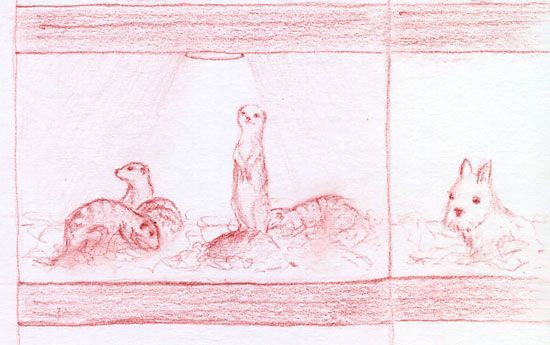
 photo meerkats_zps86e47348.jpg
Meerkats in Atocha, drawing enlarged
pencil
There was a small gap (about 7mm) in the door of the enclosure. I put my finger to it and one inquisitive meerkat sniffed then touched my finger tip! I was gleefully stoked. I’d touched a meerkat :*D For the next few days, every so often I would say to M with a big grin on my face
“I touched a meerkat.” Its paw pad was soft like my late guinea pigs’. Its claws, though pointy, were not sharp like a cat’s.


Website of the Day
Fellow Earthlings' Wildlife Center aka chock full o' meerkat goodness!


*1500 euros. I’m glad they’re not cheap. Stops people buying them on a whim. Though you would need to buy the whole troupe (at least 4) if they were to be happy pets. How cool would it be to have a big hill on your back yard and a little troupe of meerkats scurrying about?
**Though maybe I was anthropomising a typical, solitary puppy face: big, brown eyes and a doggy pout, chin down not up.