Showing posts with label environment. Show all posts

Sunday, September 03, 2023

DIY Plastic free, reclaimed aluminium can, plant tags


I work in a bush crew. One of the things I’ve noticed is that in conservation areas on significant plants they use metal swing tags/labels. I assume they are aluminium because the are inscribed and very light, with no corrosion.

I’ve come up with a way to make an economical and weather durable tag with things I have at home. 

This is a project for adults NOT kids. 
The cut aluminium can edges are moderately safe to handle without gloves if done carefully*
Avoid touching/handling the cut edges.
This project CAN NOT be completed with a steel can.


DIY Aluminium Plant Labels

You will need:

A clean aluminium can

A can opener that lifts off the top of the can

Scissors

A slightly rounded, smooth  metal point such as a darning needle. Mine is a metal fondant or wax working tool. 

A smooth blunt object to press folded metal such as a metal spoon. Mine is the other end of the aforementioned tool. 


Use can opener to remove top of can


Use scissors to cut straight along the length of the can. 
Make another parallel cut 4-5cm away from the first.
Cut between the two cuts to seperate from can.


Cut off non-flat sections from each end.

You should now have a rectangle of roughly 5x12cm


With the labelled exterior of the can facing you, fold along one long edge, about 4-5mm deep.

Fold the other long side over so that it slightly overlaps by 3-4 mm over the first fold. 


Make each fold crisp by pressing it.
Fold over from the broad fold, one corner.
Make the corner fold crisp.
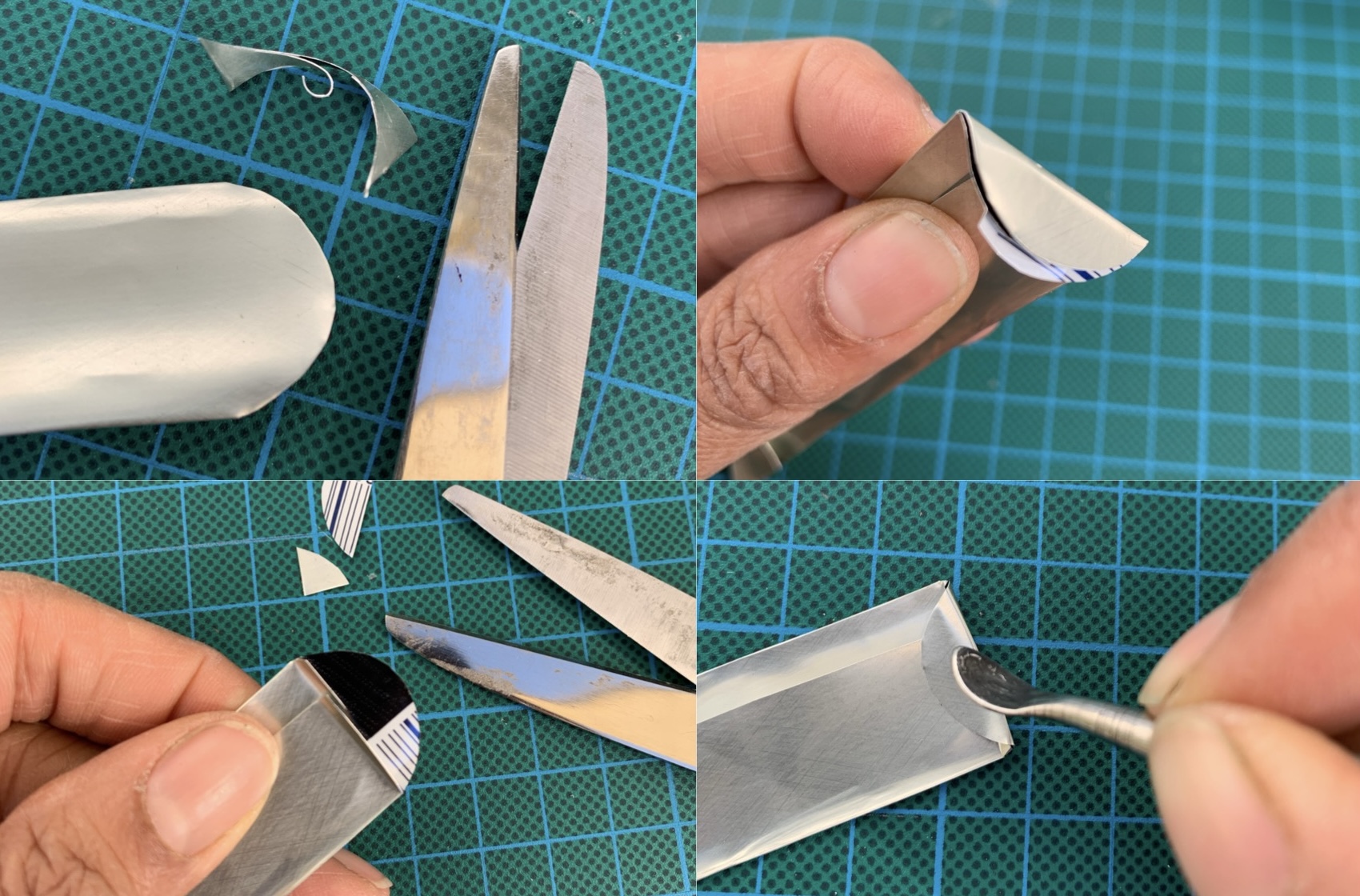

At the other end of the tag, use scissors to cut a semi circle or rounded corners.
Lightly fold over this rounded end towards other folds then fold back.
Snip off folded under layer to leave simple rounded flap.
Fold over rounded flap and press.


Use metal point to carefully write label. You will need to press so keep your lettering small and simple.


Finished!
Gently push into the soil or pot.


Label your plants however is useful to you. As a horticulturalist and revegetation worker, I want to remember the botanical names of the indigenous plants I’m planting. I’m in a rental, so I’m hoping that whoever lives here next will see these tags and respect the indigenous planting.


*While I made two cans worth of labels without cutting myself, others might not be so careful/lucky.  

Wednesday, October 05, 2016

Compulsory Palm Oil Labelling in Australia

Here we are at Federation Square, Deakin Edge last night to help promote
the petition to make labelling palm oil compulsory in Australia.
Parliament will decide next month, so it's important we get as many signatures as we can now. Hoping to get 100,000! Please help by signing and sharing.

The orangutan is the gardener of the forest, spreading seeds to create more forest, an umbrella species that others like tigers and rhinos, and countless more rely on.

#labelpalmoil #iwantthechoice #dontpalmusoff #turnmelbourneorange #inyourpalm #orangutan #endangered

Melbourne Zoo , as organisers of both the petition and event, donated 1000 orangutan plush toys which were hidden outside of Deakin Edge, and seated throughout the auditorium. The plushies were for everyone to find, as a reward for attending and promoting this important petition. These toys represent the real live orangutans lost to unsustainable palm oil production every year. At this rate they will be extinct within a decade. Attendees were actively encouraged to take selfies with their plushy, and use the hash tag #labelpalmoil when posting it on social media. Also there were bags of oranges kindly donated by Orange World. Thanks for the juicy evening snack Orange World!

Afterwards we were instructed to swarm/surround Livinia Nixon doing the weather report. I mimed my plushy Kiani, to also do the weather report. I hope we were in frame because it would have been HILARIOUS.

The lower left corner image is a live study of Maimunah, using an enrichment puzzle at the Royal Melbourne Zoo. You can see this drawing on Instagram as the initial live study if you're on there:
https://www.instagram.com/p/BLHZd1NhS-I/?taken-by=patriciadenisartist
I'll be posting an exclusive work in progress shot here.
And the final drawing here first.

Finally there is a free shopping app. for your phone to help you shop ethically now, by avoiding unsustainable palm oil. Read about it here.

Friday, September 30, 2016

Waste Deep


WASTE DEEP from SustainTable on Vimeo.

The title says it all. Made in Melbourne - I'm soproud of my city, we're awesome, we do awesome things!

Friday, September 16, 2016

Make a laundry filter for microfibres

After reading about synthetic microfibres becoming marine microplastics I was inspired by Blair Jollimore to improvise a filter I sit in my laundry tub.

 photo FilterAssembledISITU_zpsrnkijbdu.jpg

Each wash catches about a pea sized amount - when compressed into a ball between my fingers - of wet fibres. We are running a front loading washing machine with the hose running into the laundry tub rather than straight down into a pipe. If you are doing the same then this set up should work for you.

I recommend checking occasionally to see how the water is draining throughout the first wash to ensure there is no risk of overflow. It is possible to collect the fibres as they clump while there is water in the tub. Scrape your fingernails across the strainer then pinch and you should be able to clear it enough to improve the drainage. Top loader users should exercise greater caution as they do use more water, and this system will slow down the draining of water from the laundry tub.

To make this simple, microfibre laundry filter I used an off the shelf sink strainer, an oversized press button and a cut up fry splatter guard* to make a rigid filter.

 photo FilterDisassembled_zpspnidj8co.jpg

The press button allows me to detach the filter to clean it out between washes. You can find oversized press buttons at a haberdashery store. A regular sized press button may still work depending on the strainer's holes, but could be fiddly to use.

I got the stainless steel sink strainer and splatter guard from an independent kitchenware store. The fine aluminium mesh of the splatter guard is easily cut with a box cutter style, snap blade, utility knife leaving an edge that is safe to handle. The gauge of the holes is approximately 1mm. I had previously tried cutting up an old stainless steel sieve but it proved difficult to do neatly, without injury and it was tricky to clean out as a result. A scrap of flyscreen mesh while not as fine at about 2mm gauge, should still catch some fibres. When cutting the circle of the filter, it's better to cut it slightly too big in diameter than too small, because you will ensure the strainer holes are completely covered.
Confession: mine is a fraction undersized but I haven't gotten around to cutting a bigger one yet.
Attach the filter behind/under the strainer. It will filter better and be easier to clean than if you put it on top.

 photo FilterAssembled_zpsbvsc5ehp.jpg

Alternately, you can make the filter and strainer in one - ie sans button and premade manufactured strainer, basically a super fine DIY sink strainer - but I find this doesn't sit as well in the drain hole, and is prone to distortion, requiring adjustment to ensure a good fit for each use.

Clear your filter while wet after each use, by rubbing your finger over the surface.
Always remember to lift the whole assembly out of the drain hole before carefully removing the press button halves.
Avoid removing mid wash if you want to catch the most fibres.
Due to its buoyancy, there are a lot of fibres in the suds which won't drain away the way they usually do. Allow all water and frothy suds to drain and dissipate away before retrieving filter.

On the left, an entire wash's fibres, scale in millimetres. 
On the right top down from another singular wash the fibres: in the suds left in the tub post wash; cleaned from the filter only post wash; scraped from the top of the filter during the wash.

*super fine mesh, aluminium screen used when frying food that spatters. The one I used was by Metaltex.

Friday, August 05, 2016

Rejecting Plastic Bags

I don't claim to be living a plastic free life but I have made significant changes since participating in Plastic Free July last year. Do visit the site to learn more.

Here are my own top tips for rejecting single use plastic bags.

Take the plastic/rigid floor out of your reusable bags so you can fold them up smaller. 
Here is my folding technique as used on a cotton bag but it also works for any tote style reusable shopping bag.


  1. Lay it out flat.
  2. Fold the sides into line with the handles.
  3. Roll firmly into a cyclindrical shape from the base up to the handles.
  4. Take one handle in the opposite direction to the other, around the cylinder.
  5. Tie in a single, firm knot to secure.
  6. Done!
Keep at least one reusable bag in your car at all times.
Only buy what fits in that bag/s.

Be prepared but also be prepared for when you're not prepared. 

How?  
Keep a folded up reusable bag in your work bag/hand bag.
It could be one you have folded as above or a ready made, extra compact bag eg. I love my Envirosax retro robot print bag because it's compact, easy to fold, looks good (different prints brought out every year!), strong, holds a lot and can be carried on my shoulder like a tote bag. Another cool, totally plastic free option are old fashioned, cotton string bags.
When you don't have a bag, don't buy anything. You will save money if you can get by without it. If it turns out to be inconvenient because you have to carry it in your hands, or go out again, this will motivate you to get into the habit of having a bag.

Most fresh produce doesn't need to be stored in plastic bags let alone bought in them. 
You can go completely without any form of bag for things like apples, carrots etc. There are some items that are easier to manage - eg salad greens, cherries, beans, nuts - that you will need a bag of some sort for.

Re-use plastic net bags from previously bought oranges, onions and discount green groceries for all of your new purchases. Or buy/make some lightweight mesh bags which are necessary loose leaf greens and beans in particular. Keep some of these with the bag in your car, or the bag in your work bag/hand bag.
Re-use your existing plastic bags to store produce in fridge. Once you have exhausted those - if that is possible - here is a plastic free produce storage guide.

My own findings:
Broccoli will keep really well if the cut end of the stalk is kept in water - like a cut flower because that is what it is - and the whole thing is wrapped in a cotton cloth.
Celery can be temporarily stored in a tall jug or bucket of water outside of the fridge. For long term storage of cut up celery stalks, keep immersed in water in a sealed container  - thank you to my housemate S for that one!

Here is a guide to plastic free bin lining for those of us who want bin liners.
In smaller bins I arrange 3 or 4 sheets in a cross and push in to fill. To dispose of, I gather up the sides and twist firmly closed. Then I add another sheet if it looks like it won't make it intact into the garbage truck. I use this for (bagless Dyson) vaccuum cleaner contents and it's very effective.

Saturday, March 19, 2016

DIY Plant Markers


Icy pole and icecream sticks should always be saved because they are useful.  They can be used to stir a small pot of paint, to mix and apply two part expoxy resin aka Araldite, and with a pencil or waterproof pen/biro...


...they make biodegradable plant markers.


Saturday, July 27, 2013

Slugs and Snails: Make a Beer Baited Slug Trap Mark II

I made this one using an instant noodle container and an Aqua Spike. I used my Dremel to drill a hole for the spike, to hold the roof up. The dremel helped me to add a bit of artistic flair by engraving the roof. It reads: 'The Drunken Slug Inn. Snails welcome.' and the 'S' in slug is a slug :)


 photo SlugInn_zps1481cef5.jpg

Like the Mark I it seems to be most attractive to slugs rather than snails. So how do we deal with snails?

 photo CoffeeGrounds_zps209258d2.jpg

My housemate planted some cyclamens. She would usually scatter snail pellets around new plants like these but it hasn't been necessary. I had read that coffee grounds can be an effective snail deterrent so we've been scattering that closely around these new plants instead. Additionally, the grounds are a good soil conditioner. We would usually broadcast the grounds over the mulch. It feels good to use gentle, organic pest control that won't linger in the foodchain.

Friday, September 14, 2012

Queensland Sanctions Shooting Threatened Bats


I understand that the fruit industry is important to the state of Queensland but so is its natural beauty and wildlife. This is an ineffectual and cruel way to deal with loss of crops. It needs to be stopped. I would have thought endangered and vulnerable species' survival was more important in the long term than any crop. The government could be subsidising netting not allowing shooting. Why does wildlife need to have a dollar value before its custodians care for it?

Photobucket
 Series IV, Pod II, detail*
modelled on the grey headed flying fox

Please help stop this slaughter by sending an email from here / signing the petition here!


Photobucket
Series IV, Little Reds, detail*
modelled on the litte red flying fox

*Images of my sculptures taken from my folio blog here.

Saturday, February 04, 2012

A little bit about palm oil and how to avoid it.

For both your health and environmental reasons palm oil needs to be avoided. Labelling laws for palm oil vary around the world making it difficult to know what you're buying. It's an issue I felt so strongly about that I wrote to my local member of parliament about it. Disappointingly a potential law requiring its labelling was rejected in Australia.

Palm oil plantations have had a devastating effect on Indonesia's unique rainforest habitat and thus the population of endangered orangutans, Sumatran tigers, rhinoceros and thousands of other animals dependant on this ecosystem. If the destruction of this habitat for palm oil plantations isn't stopped, we could see these endangered species extinct within our lifetime.

What can you do as a consumer? Writing to your member of parliament, or signing petitions could still eventually create enough demand for change if enough people ask for it. If your government is as apathetic as mine you can still make a difference. Spread the word about palm oil and how to avoid it:

'to avoid buying palm oil, when buying food look for the label stating it is vegetable oil. Then look for saturated fat. If only vegetable oil (no animal fat listed) is used and there is 5%+ saturated fat in the product - you are buying palm kernel oil, palm oil or coconut oil, most probably palm.'

'if palm oil is used in cosmetics it must be labelled. No exceptions. However, it is usually not labelled as Palm oil. It is labelled as Elaeis guineensis. This is the name given to palm oil by the International Nomenclature Cosmetic Ingredients (INCI).'
From http://www.palmoilaction.org.au/shopping-
guide.html


A bit harder to avoid are possible palm oil derivitives:
'In non-food products like soaps and detergents, the list includes elaeis guineensis, sodium lauryl sulphate, cetyl alcohol, stearic acid, isopropyl and other palmitates, steareth-2, steareth-20 and fatty alcohol sulphates – all of which may be derived from palm oil.'
Sodium lauryl sulphate is the most common lathering agent used in toiletries.
From Borneo Orangutan Survival's site.


Further reading if you want to know more of the names palm oil deritives hide behind.

Friday, January 20, 2012

Royal Albatross - partial skull

Photobucket

At Broulee, NSW, Australia I found a partial marine bird skull which I hypothesised to be that of an albatross. I took it back down to the seashore to take some photographs of it.

Photobucket
The Ancient One
digital image

Using the Seabird Osteology site, I have since identified it as the skull of a Southern Royal Albatross. According to the bird field guide I have to hand there are two races of these species: Diomedea epomophora is endangered and the other, dark winged , Diomedea sanfordi is vulnerable. Without having seen a full corpse with feathers I can't be sure which one it is. It is a little smaller than the depicted specimen - beak is about 14cm - so I'm guessing it could be a female or going by the slight difference in eye socket shape, a juvenile.

Photobucket
Time eroded
digital image

I certainly didn't expect to find a piece of endangered bird on the beach and had to make sure it wasn't something more common like the comorants seen in the area. As it turns out, all Australian species of albatross are either endangered or vulnerable. It's not something you want to know but at least now I'm a little more informed on the subject, and thus so are you.

Thursday, November 03, 2011

Concept Radical

Finally won something for my art as an adult*: third prize in the Concept Radical art competition. In my characteristic and ironically artless way on receiving my prize
"Oh wow, I never win anything!"
Professor Carl Schiesser, Director of ARC while shaking my hand
"Well, you've won something now"
"Thank you! [big grin]"

Photobucket
Flow
digital image of collected beach flotsam

Concept Radical Art Exhibition
Free, and open to the general public
Wednesday 2 November 2011 – Wednesday 9 November 2011.
The gallery is open 11am – 5pm Monday to Friday.
George Paton Gallery, Second Floor, Union Building, University of Melbourne, Victoria.

Official site here.
Summary and details here.

*Have won things as a child. It has been a while...

Tuesday, August 16, 2011

Make a Beer Baited Slug Trap, Mark I

Slugs like beer to death and so do snails apparently but only slugs seem to come to my refurbished, Ye Happy Slug Inn (MI). It's very simple. You set up an 'inn' amongst whatever plants they are munching. Slugs go in, guzzle beer, get legless and drown - dying a happier death than they do by pellets I'm sure.

Photobucket

1. Save and wash clean a small cuttable plastic container, in this case a 1L milk bottle which has a nice wide neck.
2. Using a box cutter/stanley knife, cut container into two halves to make a shorter container. Use scissors to tidy up the edges if you wish. Make sure the lower half is tall enough to contain about 1/2 cup liquid. If using a lidded tub, cut a hole about 4cm in diameter/square in the lid to let the slugs in. A lid of some sort helps to keep rain from diluting the mixture and other larger animals from getting at the beer. If using a bottle choose one with a wide neck to waft the beer scent and invite slugs in. A soft drink bottle is too narrow, but some water and energy drink bottles have suitable wide necks.
3. Put about 2 to 3cm of beer in base of container and put on lid. I previously tried Carlton Draught which works but not as well as a Corona and Pure Blonde blend do.
4. Place amongst whatever slugs are eating. If in a garden bed you may wish to partially bury the base to 2-3cm above ground level, for stability and to ensure only slugs climb up into it and no other invertebrates fall in.
5. Check every few days to fish out dead slugs, or more frequently if it has been raining. The beer is fine to keep reusing. You will find that with warmer weather a layer of yeast will form. Although icky, yeast is what attract the slugs so you should leave it. I use an old sieve to strain out the slug carcasses and bury them in shallow graves in garden beds and pots. You could also use an old spoon to fish them out of the beer.

Photobucket
The sign is made of an offcut from the bottle, a toothpick and decorated with a mostly permanent pen (HDPE plastic is hard to write on).


Monday, June 14, 2010

Proposed close time for seals, 1873

Photobucket
Click image to see bigger version.
Proposed close time for seals
S.E. Waller
from the editorial by Frank Buckland in The Animal World, A Monthly Advocate of Humanity, Issued by the R.S.P.C.A, No. 43 - Vol. IV, April 1873

This was on the cover, illustrating an article proposing the creation of a hunting season of baby seals to allow them to reach a bigger size. Regulating this would offer the seals as a species a better rate of survival since the babies would not be quite so helpless when the time came. One would expect the later hunting season would require a swifter killing method than what was happening - leaving the younger seal pups to starve to death after killing their mothers. It would appear to ease a collective conscience albeit temporarily. He went into some gory detail about the inhumanity of the then current 'slaughter of the innocents' method. He did not call for an outright cease to hunting nor change in technique, acknowledging the economic value of the animals.

Friday, January 01, 2010

Nurdles aka mermaid tears

Nurdles are tiny plastic pellets from the plastic moulding industry. Raw plastic is formed into pre-production plastic pellets or plastic resin pellets less than 5mm in size. Their size and shape make them easy to feed into the hopper of a plastic moulding machine. Not every nurdle makes it into the hopper. Some may be spilt or blown away on the wind. These usually end up in waterways.

Nurdles are also known as mermaid tears because they make up a large portion of marine debris. Scientists have been aware of the danger of marine plastic debris for some years now*. However it is only the recent set of images of dead albatross chicks that have made a wave in the sea of public consciousness.

*So have I (see blog entry here) though not as long as they have obviously.

Rant about marine plastic debris

Never mind chaos theory's flapping butterfly: one carelessly disposed of plastic item inland, could end up in the gut of an albatross chick on a remote inland thousands of kilometres away. That object could be one of many plastic fragments and particles that will fill this bird's belly thus starving the animal to death.

Hundreds of seemingly insignificant nurdles are swallowed by other animals such as fish, leaching toxins into their bodies.

What can anyone do about any of this? We can all learn to be responsible. We can tell others about it. We can share articles and images with our friends and family to help them understand no piece of plastic is insignificant. It means life or death for the animal that eats it. That animal could indirectly be us. As the dominant species on this planet we have the capacity and therefore the responsibility for our collective actions.

Thursday, October 22, 2009

Exhibition: Paper Butterflies

Hosted by Melbourne CBD's most unique shop Wunderkammer, Paper Butterflies will be a showcase of my most recent works. Some have been shown previously while others, notably the Paper Butterflies, have been created specifically for this event.

collage,sculpture
Paper butterflies, in progress.
mixed media

About Wunderkammer:
'The shop specialises in science and natural history. In the collection are antique botanical prints, anatomical models, specimens preserved in vintage glass canisters, fossils, medical instruments, beetles and butterflies in hand blown specimen domes: the scope of Wunderkammer is as broad as the scope of human scientific enquiry. The owner of Wunderkammer, Ray Meyer, chooses the objects for the collection based on standards of beauty, rarity, historical or educational value and, of course, the ability to inspire wonder. '

Paper Butterflies
Exploring our relationship with nature and the ephemeral.
Oct 23 to Nov 24th 2009

OPENING NIGHT: Friday 23rd October from 6pm

Wunderkammer
439 Lonsdale Street
Melbourne, Australia
Opening Hours:
Tuesday-Friday 10AM-6PM
Saturday 10AM-4PM
Enquiries:
96424694
info@wunderkammer.com.au

Monday, July 06, 2009

Big show coming up: Slide Rules Have No Place At My Party.

This is one of several of my new, sculptural works that will be featured at Brunswick Arts Space from next Friday.
Photobucket
Lime and Soda
mixed media, framed sculpture

limesodaDETAIL
Lime and Soda, detail showing scrimshaw

Lime and Soda is about how the increased amount carbon dioxide in the atmosphere affects our oceans. The ocean naturally absorbs carbon dioxide but if it continues to absorb at the current rate we will see acidification. This affects the entire ocean food chain from the tiniest creatures upwards due to the negative affect on seashell integrity. The scrimshawed, seagull craniums depict a carbonic acid molecule and the degradation* of a seashell in simulated, acidified ocean water.

Slide Rules Have No Place At My Party.
An exhibition of small scale sculpture and other media.
Curated by Monica Zanchetta.
Opening July 17th, 6-9pm
17 to 31 July 2009
Brunswick Arts Space
2a Little Breese Street
Brunswick, Australia
Gallery Hours: 12-5 Thursday to Sunday

I will post images of artwork from this show when it's over, here

For those of visiting the show at any point, please note that from my bat sculptures, 10% of the proceeds will go to the Tolga Bat Hospital in Queensland. So you can help a poor artist AND an orphaned or injured bat!

*Based on photographs from National Geographic, 2007. Click for further reading

Monday, May 04, 2009

JAW Cooper, Illustrator

Listening to: No You Girls, by Franz Ferdinand, from Tonight

Via Phantasmaphile blog, JAW (aka Jessica A.W.) Cooper's gorgeous illustration and design folio
I like how some of her art is inspired by science - something I relate to - then taken to a fantastic yet logical conclusion, the creature design, the grace and beauty of her animal study sketches, the overall amazing drawing skills, and the slightly Japanese style of some of her work. While I can certainly draw to save myself, I wish I could draw like her!

It's carbon dioxide not happiness, you git!

The first time I saw this months ago, I had a rant to whoever was in ear shot. I seldom have cola except on tap. I got a free bottle yesterday with my lunch and I still feel ranty.

[rant]
Perhaps this is why the world is heating up and politicians aren't taking it seriously and taking action:

Photobucket
detail from current label of Coke.

They think all that carbon dioxide building up in our atmosphere is HAPPINESS. Tonnes and tonnes of happiness.
[drips with sarcasm and makes quotey fingers]:
Yes the world needs more of this 'happiness'.
Deity on a bike, it's carbon dioxide not happiness you gits at Coca Cola!!!
[rolls eyes ]
Grrr...
[/rant]
Okay I feel a tiny bit better :P