Showing posts with label backyard natural history. Show all posts

Sunday, September 03, 2023

DIY Plastic free, reclaimed aluminium can, plant tags


I work in a bush crew. One of the things I’ve noticed is that in conservation areas on significant plants they use metal swing tags/labels. I assume they are aluminium because the are inscribed and very light, with no corrosion.

I’ve come up with a way to make an economical and weather durable tag with things I have at home. 

This is a project for adults NOT kids. 
The cut aluminium can edges are moderately safe to handle without gloves if done carefully*
Avoid touching/handling the cut edges.
This project CAN NOT be completed with a steel can.


DIY Aluminium Plant Labels

You will need:

A clean aluminium can

A can opener that lifts off the top of the can

Scissors

A slightly rounded, smooth  metal point such as a darning needle. Mine is a metal fondant or wax working tool. 

A smooth blunt object to press folded metal such as a metal spoon. Mine is the other end of the aforementioned tool. 


Use can opener to remove top of can


Use scissors to cut straight along the length of the can. 
Make another parallel cut 4-5cm away from the first.
Cut between the two cuts to seperate from can.


Cut off non-flat sections from each end.

You should now have a rectangle of roughly 5x12cm


With the labelled exterior of the can facing you, fold along one long edge, about 4-5mm deep.

Fold the other long side over so that it slightly overlaps by 3-4 mm over the first fold. 


Make each fold crisp by pressing it.
Fold over from the broad fold, one corner.
Make the corner fold crisp.
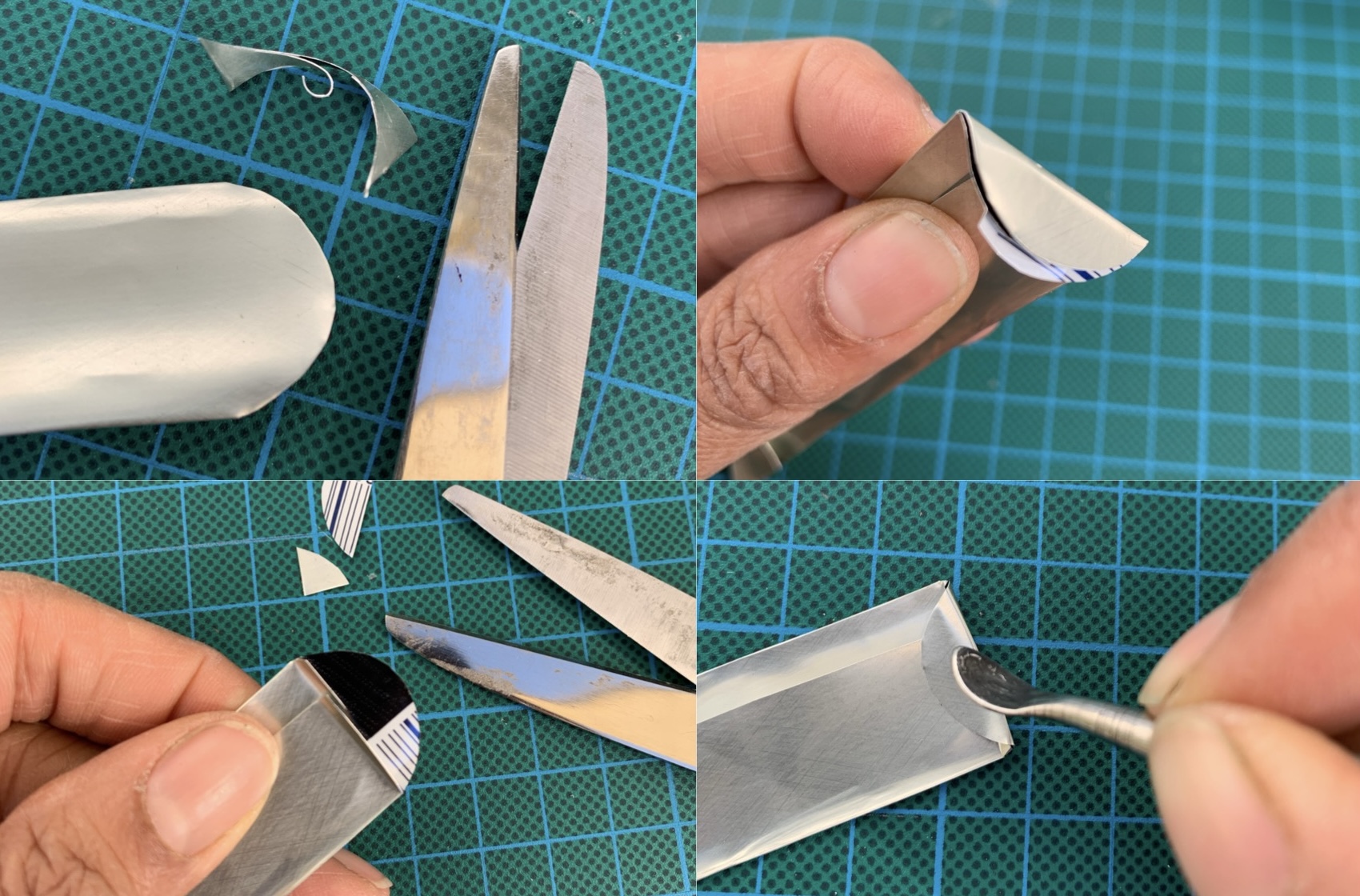

At the other end of the tag, use scissors to cut a semi circle or rounded corners.
Lightly fold over this rounded end towards other folds then fold back.
Snip off folded under layer to leave simple rounded flap.
Fold over rounded flap and press.


Use metal point to carefully write label. You will need to press so keep your lettering small and simple.


Finished!
Gently push into the soil or pot.


Label your plants however is useful to you. As a horticulturalist and revegetation worker, I want to remember the botanical names of the indigenous plants I’m planting. I’m in a rental, so I’m hoping that whoever lives here next will see these tags and respect the indigenous planting.


*While I made two cans worth of labels without cutting myself, others might not be so careful/lucky.  

Thursday, August 04, 2016

Edible Weeds, Chickweed.

I got into edible weeds, and foraging in my garden via a book from CERES called Edible Weeds of Melbourne. You can find out more about it here.

 photo chickweedGARDEN_zpsyrznovjq.jpg
Chickweed growing in my garden. A seasonal weed, it is abundant during Winter coming into flower in late Winter, before dying off in Spring.

 photo chickweedPLANT_zpss9va4tb3.jpg
Clockwise from top left: typical growth - note the pointed leaf tips and alternating leaf pairs along the stem, in bud, section of plant with some roots, in flower like a tiny daisy.

Forage harvesting can be done in one of two ways. If you have the time and have an abundance of chickweed, you could weed  it out of the places you don't want it and snip off the best tendrils from the root hub. Or, if you can't be bothered with that, just snip off what you need from the plant. The snipping method is also cleaner because you aren't disturbing any soil.

 photo chickweedCHOPPED_zpsgsu5rw6f.jpg
Roughly chopped chickweed. While edible in lengths it's more palatable roughly chopped, and easier to stir through food.

After washing and draining, tip harvest into a pile on chopping board.
Make a some cuts across the pile in two directions to roughly chop it. You're are aiming to reduce the tendril lengths rather than end up with something finely chopped. It isn't necessary to be precise. That said, you might prefer a fine chop for your dish.

Use as you would spinach or any other greenery in its cooked form. I have it sautéed with garlic chives or garlic, wilted as an accompaniment to poached eggs, mixed into scrambled egg mixture, in curry, stir fried, wilted with pasta and pesto and a baked potato. The entire plant stems, flowers, and buds is fine to eat, but raw, only the fingernail-sized leaves are recommended and that is waaay too much mucking about for me!

Friday, January 09, 2015

Snail and slug trap Mark III: The Final Design.

I've made a few versions of slug and snail beer traps and here is another one to try.

Take an empty, single serve, lidded yoghurt pot and remove the cardboard outer sheath:
 photo SlugtrapWhole_zps41fe36da.jpg

Remove the lid and cut an aperture in it using a cutting knife or strong scissors/shears. Make the hole big enough to take an adult snail but small enough so that the lid still clips on to keep out most of the rain:
 photo SlugtrapLid_zpsa8accac8.jpg
 photo slugtrapCut_zps6593be4b.jpg

Examples of shapes you can cut into it and some decoration because I can't help myself:
 photo slugtrapV_zps353c88b5.jpg
 photo slugtrapDeco_zpsded2018c.jpg

In situ in my sister's veggie patch, partially buried for stability and access, freshly baited with Carlton Draught
 photo slugtrapBeer_zps389e0d66.jpg

The same idea using a single serve, microwave soup bowl instead.
 photo EscargotInn_zps03a94ccd.jpg
The lid can be a bit trickier to get off and it needs more beer but it works as well as the yoghurt pot version if not better. It's very stable, doesn't blow over in the wind, doesn't need to be buried to capture, evaporation is minimal, it keeps out the rain and water from the hose. One way to improve it would be to cut the hole to the edge like the yoghurt pot for easier lid removal.


Saturday, December 06, 2014

Clever Rats

 photo CleverRats_zps407def2f.jpg
Clever Rats
Image by Whymper* (first name uncertain) from The Child's Companion and Juvenile Instructor, Vol. XXXIII, 1893, page 121

'The sagacity of rats is a fact that has long been known to naturalists. La Fontaine, in his "Fables," records that "Two rats in foraging, fell on an egg." And the story goes on to tell how
"Brimful of joy and appetite,
They were about to sack the box
So tight without the aid of locks,"
when a fox came into sight. Eager to save their booty, one turned upon his back holding the egg in his paws, and the other dragged him along by his tail to a place of safety.'

Then the following anecdote:

'The other day a son of mine, about eleven, said that through a chink in the floor he could see a rat rolling something that seemed like an egg. I got a saw and cut away the board, and found seven perfectly fresh eggs, not a crack in any except where I had unfortunately cracked a couple with my saw, and we could see that they were quite freshly broken. The nursery (the room in question) is upstairs, and as none of the hens ever lay within thirty or forty yards, and the eggs are collected every day, at what time they (the rats) went to work, or how they got them up the stairs, I can not imagine. We have often missed by the evening the eggs we had seen in the morning, and thougtht the hens had eaten them.'


*Probably Edward Whymper in an enjoyable side project? He was both a professional engraver and a famous mountaineer hence why he he listed as one of the 'etc' illustrators rather than listed by name. The etching signature matches known works.

Saturday, December 14, 2013

Humane Anti Bird Barrier - ground plants and seedlings.

 photo AntiBirdSpikes_zpsd03d6c67.jpg
A free and easy way to protect young plants and seedlings from foraging birds. Blackbirds in particular like to forage through garden beds flicking mulch and dirt about in their search for food. They often dig up young plants in the process!

We have used bamboo twigs neatly placed in 'A' shapes as shown above but a triangular teepee or encircling fence in similar proximity will work as well if not better. You don't have to use bamboo -any stick or twig will do. It needs to be sturdy and long enough so it won't be easily dug up and is close together enough to prevent the bird from getting close to the root system or the plant itself. More rather than less is best for delicate seedlings. As the plant gets older you can pull them out. With found twigs you can be a bit lazier and just leave them there to disintegrate.

A larger version of this system also works well for stopping your dog from continually peeing on a plant.

Saturday, December 07, 2013

Forest Spirit Tree

 photo GhibliHouse_zps8544db1b.jpg
This dead tree overgrown with vines near J's house used to remind me of The Forest Spirit (Shishi-gami) from Princess Mononoke by Studio Ghibli. It was cleaned up and cut down last year. That's a full moon in the sky behind it.

Monday, August 26, 2013

Homemade white fly sticky trap

 photo FrogYellow_zps124952e9.jpg
Essentially all you need is something yellow, weather resistant and sticky with a decent surface area. The whiteflies are attracted to bright yellow and orange.

We found some plywood frog cutouts at the last hard waste collection as well as some yellow enamel paint. I combined the two with a spike made from some broken garden lattice.Obviously it will still work if its a plain old rectangle but I had the frogs so why not make them ornamental?

I tried painting used motor oil onto them to act as a sticky surface but it wasn't particularly sticky, it ran down it and was a bit dark. Smearing it with an old pot of vaseline based lip balm worked a treat as pictured.

Thursday, February 28, 2013

Old English Sheepdogs

Examples of adorable old English sheep dog photos by owners Cees Bol and Hanneke van de Watering are all over the net right now but many sites have posted a broken link - or no link - to the complete flickr set.
foggy morning dogs
Here is the link you need to find more of it. Hopefully I've helped some of you find it via google search? I found it by looking up 'Cees Bol flickr'.

In other news I've just revamped the Meerkat Clippings template! It's not wildly different from the old one because I liked the old one - like the pair of comfy warm slippers I'm getting reaquainted with now that Summer is finally over. However the format was inflexible for someone with little knowledge of html. Finally I can post wider images for your delectation and illumination. Enjoy.

Friday, February 15, 2013

Protect your fruit from birds and bats

Green Thumb's Tips for the Day:
Protect your fruit crop from birds and bats without harming them and without spending a cent! Save every bit of netting you can from bags of oranges, garlic, onions and other green groceries. Tulle works if you have some scraps of it as we did (found some bright pink tulle at hard waste). Wrap and bag groups of fruit in the netting and secure with clothes pegs. Don't wrap groups too tightly or they may rot from being pressed against each other - they need a bit of air around them. Put over the biggest or most sun exposed fruit first as these will the first to get the critters' attention. For the most part it works. Washing the netting in laundry soap and not rinsing it seems to help a bit too. We stumbled onto that by pulling apart an old cleansing puff for netting.

 photo TIPnetfruit_zps2e776710.jpg

You will lose whatever isn't netted. We couldn't reach it all so that was expected. The animals will take the path of least resistance and eat the unnetted ones first. Late in your crop when there isn't much left they will magically get at what is netted. Those rainbow lorikeets have dextrous mouths! We had some losses but we got more than we could eat before that point. We stewed up most of it, sans sugar, and stored it in the freezer to enjoy for the next few months. It's delightful, warmed with cool, plain yoghurt on top - with an optional light sprinkle of quick oats if you're having it for breakfast.

Listening to: Come Undone by Duran Duran, from Duran Duran (The Wedding Album).

Apricots: pure happiness and sunshine.

It could be said that our apricot crop is pure sunshine and happiness...

 photo HappyApricot_zps23c50768.jpg
January 2013

...Or that a short shelf life and susceptability to bruising from the harvesting basket is a small price to pay for the ultimate in zingy, sweet, flavourful tastiness.

Either way it was awesome :) Store bought apricots are to our crop, what a chocolate coin is to a Belgian chocolate truffle.

Listening to: What Else is There? by Röyksopp from The Understanding

Saturday, January 05, 2013

Amicable Green Grocer Cicada

Walking through the front garden I heard a buzzing, whirring sound like clockwork. I turned back to find a cicada struggling to right itself on the concrete. Naturally I picked it up gently and it made itself very comfortable indeed - so much so that I went inside with him to get my camera and out again to take these shots.

Photobucket
First we sat down and I marvelled at the three reflective dots on his head. They seemed a lot like eyes but they are clearly quite different from the prominent compound eyes on this Green Grocer Cicada.

Some later research revealed that they are dorsal ocelli (oh-sell-ee). They are a 'simple' - as opposed to compound - eye on the top of the head. These ocelli are very light sensitive and quick, and it is theorised that they allow flying insects to maintain stability in flight.

Photobucket
He reminded me of a frog - the way he clung to my hand, his green compact body and his bulgy buggy eyes. Cute...

...But I couldn't sit there all afternoon holding him so I tried to convince to get on to the magnolia tree...
 Photobucket
...but he wouldn't have it.

After attempting to move him to my left hand I noticed he preferred to move backward rather than be prodded forward thus - success!
Photobucket
Such an amicable chap was he.

Photobucket
"This is LaTegra. It's a little bit softer - I use this one for catolog shots a lot." *

I hope he fares alright. His rumpled wing edges might be why he struggled a bit.


*Zoolander quote C/O my BF, J.


Tuesday, December 25, 2012

The first year of Fonzie the Corgi

Fonzie is a Cardigan Welsh Corgi.
Photobucket

He has remarkable ears - everyone remarks on them.
Photobucket

Like others corgis, he does the 'chicken legs' ...
Photobucket

... and has fabulous, 'tocks / floofy pantaloons.
Photobucket

Apparently he isn't cute enough to get onto Cute Overload. Whisky Tango Foxtrot to that.
Photobucket

Like other corgis he gets into some strange and amusing sleeping positions ...
Photobucket

... providing a neverending source of distraction and amusement.
Photobucket

Which ever way you look at him...
Photobucket Photobucket

...he is a charismatic chap.
Photobucket


FonzieRope
Photobucket

Saturday, December 22, 2012

Cole's Funny Picture Book Paper Butterflies

I have two framed paper butterflies in a book art show at Hand Held Gallery.
They are made using paper from Cole's Funny Picture Book.
Photobucket
Photobucket
Photobucket

Summer BAZE
Book Arts and Zine Exhibition
From December 20-24, 2012
&
January 16-23, 2013
@
Suite 18, upstairs
Paramount Arcade
108 Bourke Street
Melbourne, 3000

Entry via Bourke or little Bourke street. Go straight up escalator to top level.

Contact:
(03)9654 4006
Megan at:
littleredfishy@yahoo.com.au

Gallery opening hours:
Tue-Sat 12-5pm

Saturday, November 17, 2012

Even more Spring blooms.

This time the blooms have been chosen not so much for their beauty - which is still there - but for their unusual structural qualities.

A rose reminiscent of a love heart:
Photobucket

Some rose buds:
Photobucket

Cephalopodlian Aquilegia buds (I think they look like squid, my housemate F thinks the greenish ones look like seamonster heads):
Photobucket
Photobucket

The same bud but a pretty shot:
Photobucket